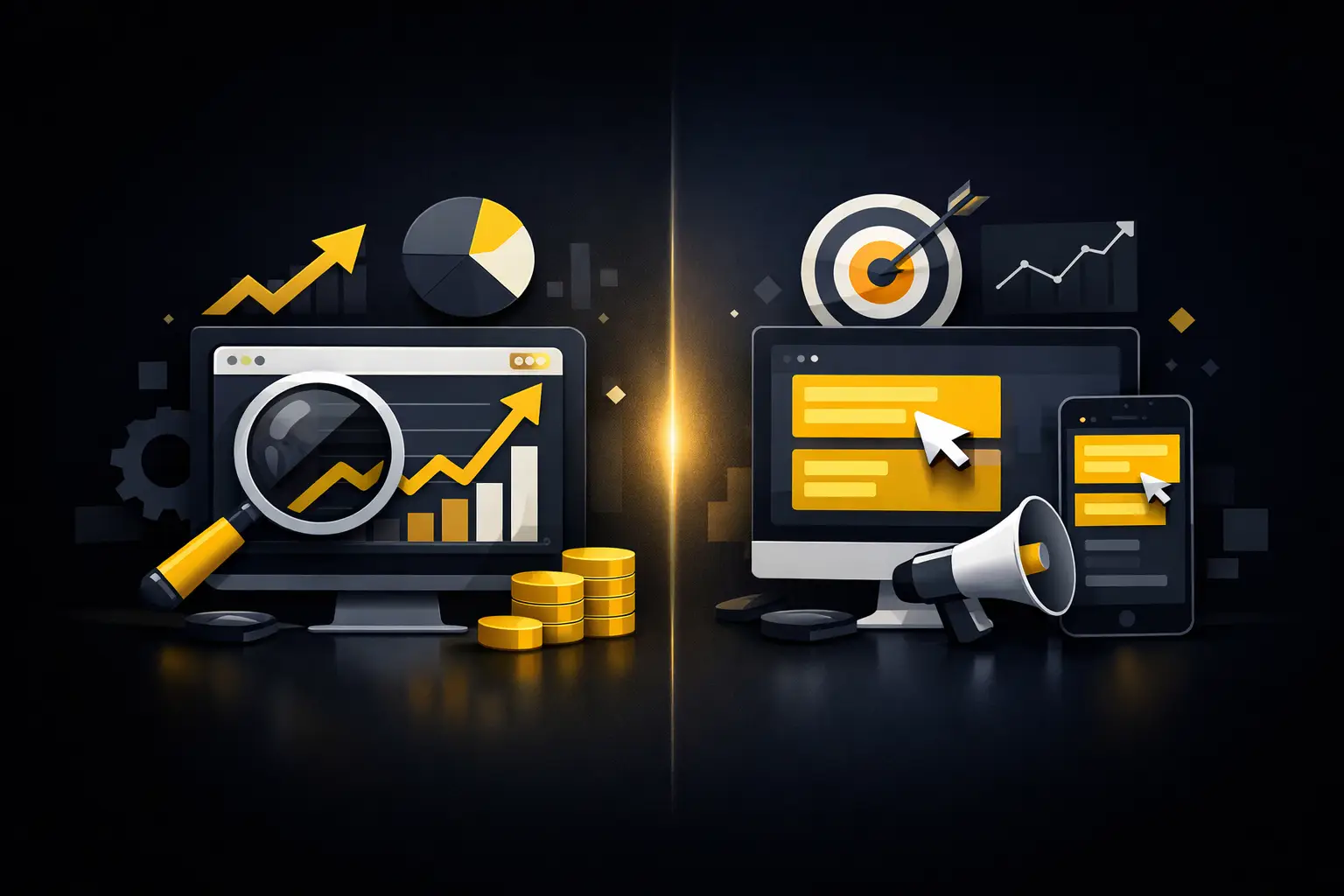
If you have to choose between SEO or Google Ads, the real question is not which one is better in general. It is which one is better for your business, your margins, your sales cycle, and your growth target. A local service business chasing leads this month will make a different call from an eCommerce brand trying to lower customer acquisition costs over the next 12 months.
Too many agencies treat this like a philosophy debate. It is not. It is a commercial decision. You are investing money to generate revenue. The right channel is the one that gets you qualified traffic, converts that traffic, and does it at a cost your business can sustain.
SEO or Google Ads: the core difference
SEO earns visibility over time. You improve your website, content, authority, and technical foundations so Google is more likely to rank you for relevant searches. When it works well, you build a compounding asset. You are not paying for every click, and strong rankings can keep producing leads and sales long after the work is done.
Google Ads buys visibility immediately. You bid on keywords, write ads, send traffic to landing pages, and pay when someone clicks. Done properly, it is fast, measurable, and highly controllable. You can test offers, locations, audiences, and intent quickly. You can also burn budget quickly if the account is poorly structured or the landing page is weak.
That is the first trade-off. SEO is slower to build but often more efficient over time. Google Ads is faster to launch but requires ongoing spend to keep the pipeline moving.
When SEO makes more sense
SEO usually wins when your business needs consistent demand generation and has the patience to build it properly. If people are actively searching for your services, and those searches happen every month, ranking well can become one of your best-performing acquisition channels.
This matters for businesses with long buying cycles, high trust requirements, or repeat search demand. Think legal services, healthcare, trades, finance, B2B providers, and many local service businesses. If a prospect wants to compare options, read reviews, understand your offer, and visit your website more than once before enquiring, SEO gives you more chances to be found across that journey.
SEO also makes sense when paid clicks are expensive. In some industries, cost per click can be high enough that scaling through ads alone becomes hard to justify. Organic visibility helps reduce reliance on paid media and improves your blended acquisition cost.
But SEO is not free. That idea needs to be retired. Good SEO takes strategy, content, technical work, link authority, and ongoing optimisation. It also takes time. If your website is weak, your category is competitive, or your location has strong incumbents, results will not appear overnight. The upside is that once momentum builds, the economics often improve.
When Google Ads is the smarter move
Google Ads is the better choice when speed matters. If you need leads now, have sales capacity ready, and know your offer converts, paid search can put you in front of buyers quickly.
This is especially useful for new businesses without organic visibility, seasonal campaigns, product launches, or businesses entering a new market. It is also strong for high-intent searches where someone is close to taking action. If a person searches for an emergency service, a quote, or a product with buying intent, ads can capture that demand immediately.
Google Ads also gives you cleaner testing conditions. You can test messaging, pricing angles, landing pages, and conversion paths faster than SEO allows. That makes it valuable beyond lead generation. It can sharpen your broader marketing strategy.
The catch is simple. Once you stop spending, the traffic stops. If your campaign economics are poor, more spend just scales inefficiency. Strong ad performance depends on account structure, keyword selection, match types, negative keywords, ad copy, landing page quality, and conversion tracking. Miss any of those, and the numbers lie.
SEO or Google Ads for different business stages
Early-stage businesses often lean too hard toward SEO because it sounds cheaper. Established businesses often over-rely on Google Ads because it is easier to measure week to week. Both can be mistakes.
If your business is new, SEO may be the right long-term move, but it probably should not be your only growth channel. You need data, conversions, and real market feedback. Ads can give you that faster while your organic foundations are being built.
If your business is more established, SEO can become a margin lever. You already know what converts. You have customer data, case studies, and a clearer value proposition. That gives you a better base for organic growth. At the same time, paid search can still play an important role in protecting branded traffic, filling short-term gaps, and dominating high-value terms.
In other words, business stage matters. So does cash flow. A business with healthy margins and strong close rates can often justify aggressive paid acquisition. A business with tighter margins may need a more balanced mix.
Cost, speed, and compounding value
If you are deciding on ROI, look beyond the monthly invoice. Compare channels across three practical factors: time to results, cost to acquire a customer, and staying power.
Google Ads usually wins on speed. You can launch quickly and start generating data within days. That is useful if your business needs enquiries this month, not next quarter.
SEO usually wins on compounding value. A strong page can keep attracting qualified visitors month after month. Your cost per acquisition often improves over time if the strategy is solid and your site converts well.
Cost is more nuanced. SEO has upfront and ongoing costs, but traffic does not stop the moment you pause spend. Google Ads can be tightly controlled, but it is sensitive to click inflation, competition, and landing page quality. Cheap clicks mean nothing if they do not convert. Organic traffic means little if the wrong people are landing on your site.
This is why channel decisions should never be made in isolation. Your website, offer, sales process, and tracking setup all affect ROI.
The strongest answer is often both
For many SMEs, SEO or Google Ads is the wrong framing. The better approach is using both, with clear roles for each.
Google Ads captures immediate demand. SEO builds long-term visibility and lowers dependence on paid traffic. Ads show you which keywords convert. SEO helps you turn those insights into durable search visibility. SEO content can improve your remarketing audiences and support branded search. Paid search can fill the gap while your organic rankings grow.
This is where a full-funnel view matters. A prospect might click an ad first, leave, come back through organic search, then convert after reading your service page or reviews. If you judge channels too narrowly, you will underinvest in what is actually driving revenue.
The businesses that get the best results usually stop asking which channel is superior and start asking how each channel should contribute to growth.
How to choose the right mix for your business
Start with your goal. If you need qualified leads fast, Google Ads is often the first move. If you want to reduce paid reliance and build a stronger acquisition engine over time, SEO deserves investment early.
Then look at your numbers. What is a new customer worth? How long does it take to convert them? What can you afford to spend to acquire one? If your lifetime value is strong and your sales process is proven, paid search can scale. If your margins are tighter, organic growth may need to carry more weight.
Next, assess your current position. If your website is poor, neither channel will perform as well as it should. If tracking is broken, you cannot judge ROI properly. If your Google Ads account is generating clicks but not qualified leads, the issue may not be the channel. It may be the setup. The same goes for SEO. Low traffic is not always the problem. Weak intent alignment and poor conversion paths are common culprits.
Finally, be honest about timeline. SEO rewards consistency. Google Ads rewards precision. Both punish shortcuts.
A smart agency should be able to tell you when not to spend more, where the bottleneck is, and what needs fixing first. That is a big part of the value. At Dizian Digital, that usually means looking at the full picture - traffic quality, conversion rate, revenue, and reporting clarity - before recommending a channel mix.
If you are weighing SEO or Google Ads, do not choose based on hype, habit, or what worked for another business. Choose based on how your customers search, how fast you need results, and what will drive profitable growth. The right answer is the one your numbers can defend.

.svg)



.webp)




.svg)

.webp)

.webp)