
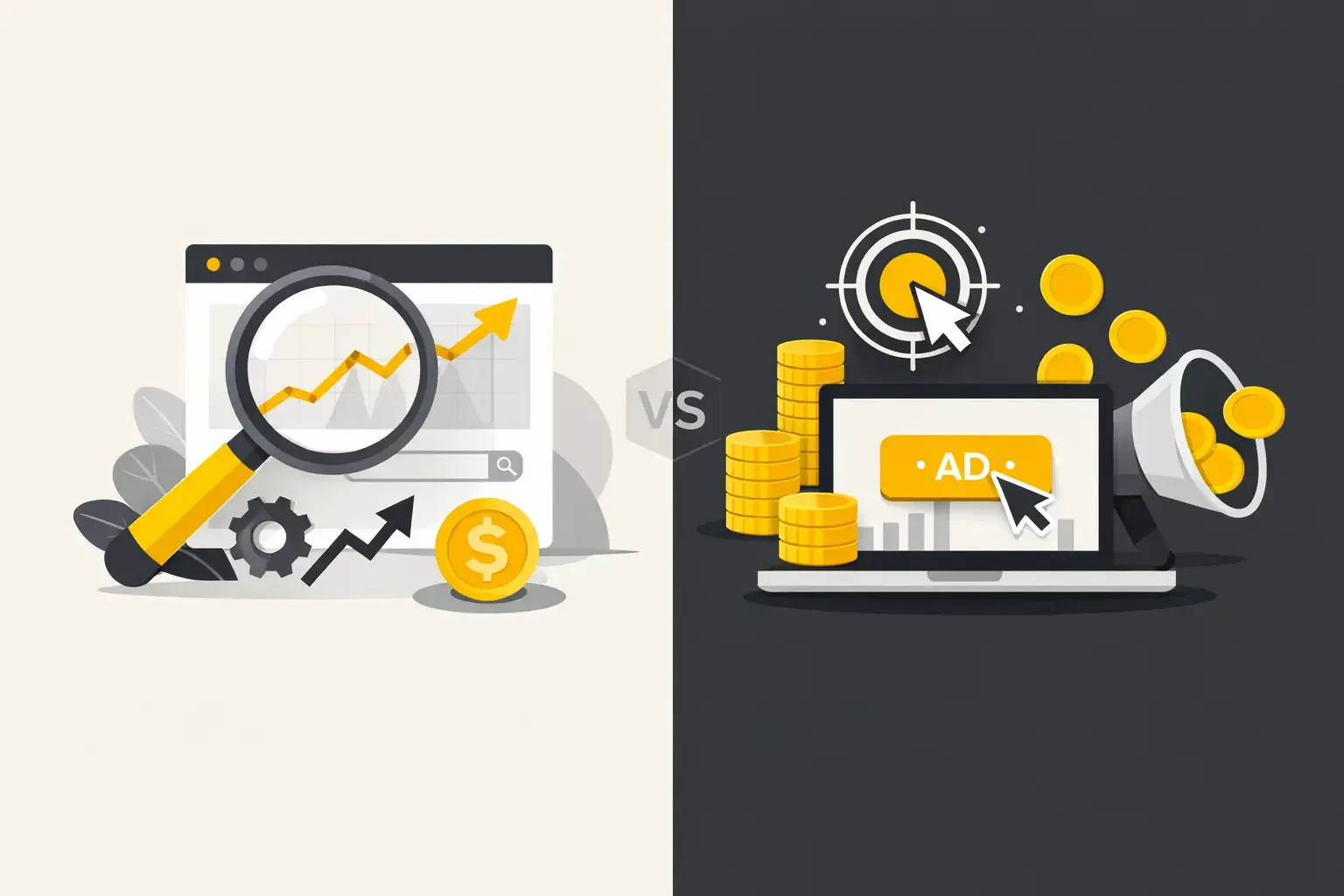
A Melbourne plumber needs calls this week. A B2B software firm needs a predictable pipeline six months from now. Both are asking the same question: SEO vs PPC for leads - which channel will produce a better return? The honest answer depends on your sales cycle, margins, market competition, website and appetite for short-term versus long-term investment.
Google Ads can put your offer in front of high-intent buyers quickly. SEO earns visibility over time and can lower your cost per lead as your presence grows. The strongest growth strategies often use both. But only when each channel has a clear job to do.
SEO vs PPC for leads: the real difference
PPC, usually Google Ads, buys placement in search results. You choose the keywords, set a budget and pay when someone clicks. If your account, landing pages and tracking are set up properly, you can begin gathering useful lead data within days.
SEO improves your ability to appear organically when people search for services, products and answers related to your business. That includes your website pages, local visibility, Google Business Profile and the content that proves your expertise. You do not pay for each organic click, but you do need to invest in technical fixes, content, authority and ongoing optimisation.
The key difference is control versus compounding value. PPC gives you immediate control over targeting, messaging and spend. SEO builds an asset that can keep attracting qualified visitors without an incremental click cost.
Neither channel creates revenue by itself. A slow website, unclear offer or poor follow-up process can make either one look ineffective. Before comparing channel costs, make sure you can track calls, forms, bookings and sales back to the source.
When PPC is the better lead generation choice
PPC suits businesses that need demand now, have a proven offer and can respond quickly to enquiries. A legal practice opening a new service line, a fitness studio promoting a membership offer or a local trade business with spare capacity can use search ads to reach people already looking for help.
It also gives you a fast way to test commercial assumptions. You can see whether people search for a service, which messages earn clicks and which keywords produce genuine enquiries. That data can improve your website and guide your SEO priorities.
PPC is particularly useful when:
- your business has a time-sensitive offer, launch or seasonal campaign
- you operate in a highly competitive market where organic visibility will take time to build
- you need leads in a specific location, such as Cheltenham, Dandenong or Glen Waverley
- you want to test new services, audiences or landing-page messages before making a larger investment
The trade-off is simple. The traffic stops when you stop funding it. Click costs can also climb fast in competitive sectors such as legal, healthcare, finance and home services. A cheap click means very little if it produces irrelevant enquiries or no sales.
Good PPC management is not about spending the full budget. It is about directing budget towards searches that create profitable opportunities. That means excluding poor-fit searches, matching ad copy to intent, sending visitors to focused landing pages and measuring lead quality after the form is submitted.
When SEO delivers a stronger return
SEO is a better fit when your customers research before they buy, your service has consistent search demand and you want to reduce dependence on paid media over time. It is especially valuable for businesses with multiple services, locations or product categories that customers search for throughout the year.
A well-built SEO program can help a physiotherapy clinic earn local enquiries for high-value treatments, a B2B provider attract decision-makers researching a problem, or an eCommerce store bring in product-category traffic month after month. The result is not just more sessions. It is a larger share of the searches that matter to your business.
SEO takes patience because Google needs to understand, trust and rank your content against established competitors. New websites and crowded markets generally need more time and better execution than businesses with a strong existing site. Anyone promising a fixed ranking date is selling certainty they do not control.
But the economics can become compelling. Once your priority pages earn consistent visibility, every extra visit does not come with another ad charge. Your content can also support sales conversations, email campaigns and AI-driven discovery platforms where customers increasingly ask detailed questions before visiting a website.
SEO works best when it focuses on commercial pages first. A service page that answers a buyer's question, explains the process, shows proof and makes it easy to enquire is often more valuable than ten broad articles chasing traffic with no buying intent.
Lead quality matters more than channel volume
A campaign that produces 100 form submissions can still lose money. Maybe the leads are outside your service area. Maybe they want the cheapest option. Maybe your team contacts them two days later, when they have already chosen someone else.
Judge SEO and PPC on qualified leads, booked appointments, quote value, revenue and customer acquisition cost. For eCommerce, use profitable revenue and return on ad spend, not only transactions. For service businesses, connect marketing data with your CRM or sales process so you can see which keywords and channels create customers.
PPC often makes this analysis easier at the start because keyword-level data arrives quickly. SEO needs more time and broader analysis, since customers may visit several pages before converting. That does not make SEO less accountable. It means you need proper analytics and a reporting view that follows the customer journey rather than crediting the last click alone.
There is another practical difference. PPC captures people searching for exact high-intent terms now. SEO can capture those searches too, while also building awareness earlier in the decision process through useful category, service and comparison content. If your sales cycle is long, that wider presence can influence leads before they are ready to enquire.
How to decide where to put your budget
Start with your commercial target. If you need 20 additional qualified leads this month, PPC will usually be the faster route. If you want to lower your reliance on paid clicks and build an acquisition channel that grows over the next year, SEO deserves consistent investment.
Then look at your unit economics. Calculate what a new customer is worth, your gross margin and how many leads your team converts into sales. If you can afford to pay $150 for a qualified lead that converts profitably, PPC may scale well. If keyword clicks cost $30 and your conversion rate is weak, fix the landing page and offer before increasing spend.
Next, assess your current position. A website with useful service pages, healthy technical foundations and some existing organic visibility may see more immediate value from SEO than a brand-new site. Conversely, a new business with no search presence may use PPC to generate leads while its SEO foundation develops.
Competition matters, but it should not dictate your strategy alone. Expensive ad auctions can make SEO more attractive. Tough organic competition can make PPC essential while you build authority. The answer often sits in the numbers, not in a blanket rule.
The case for using SEO and PPC together
Treating SEO and PPC as opposing choices can create a false decision. The channels work well together when they share data and a commercial goal.
Use PPC search-term data to identify services and questions worth targeting with SEO. Use SEO insights to improve ad relevance and landing-page copy. If you rank organically and run a paid ad for a high-value term, test the combined impact on qualified lead volume rather than assuming one channel cannibalises the other.
For many SMEs, a sensible approach is to use PPC for immediate demand capture while investing steadily in the pages, local signals and content that will reduce paid dependency later. The split should change as performance changes. There is no prize for sticking to a 50-50 budget if one channel produces better-margin customers.
Dizian Digital approaches this as a measurement problem first. Clear tracking, live reporting and ongoing optimisation give you a factual basis for deciding what to scale, pause or fix.
Your best channel is the one that produces profitable customers at a cost your business can sustain. Start with the gap you need to solve now, measure what happens after the lead arrives, and keep shifting investment towards the work that creates real revenue.